Agosta, the Pigeon-Chested Man, and Rasha, the Black Dove

- Artist: Christian Schad
- Date: 1929
- Medium: Oil paint on canvas
- Dimensions: unconfirmed: 1200 × 800 mm
- Museum: Tate Modern
- Collection record: Tate Modern website
Listen to the free audio guide
About this artwork
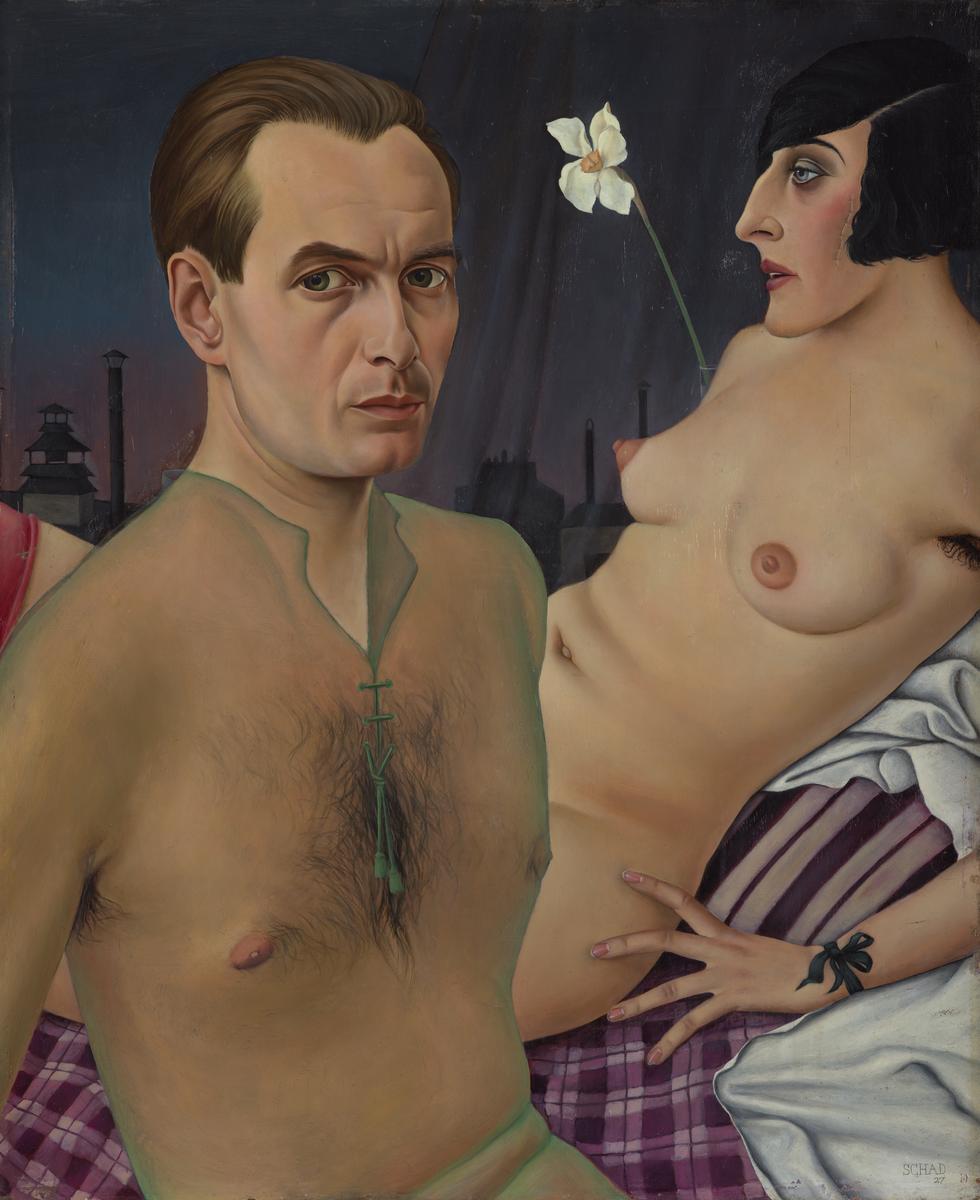
This is the painting “Agosta, the Pigeon‑Chested Man, and Rasha, the Black Dove” by Christian Schad. Created in 1929, the work is a large, portrait‑oriented oil on canvas that feels almost photographic in its detail. The scene opens on a simple background of purples, blues and greys. Agosta sits on a high‑backed chair that looks almost throne‑like; he’s half‑naked, wrapped in a black and white robe, and his chest is unusually pronounced. His expression is confident, almost arrogant, and he looks straight at us, turning slightly to the right. At his feet, Rasha—a black woman from Madagascar—appears from the chest up, frontally, wearing a red and white halter‑neck top. She gazes back at the viewer with a calm, impassive look.
Schad met both performers at a funfair in northern Berlin where they were part of a sideshow act that highlighted their bodies as “exotic.” The painting can be read as a critical glance at that objectification, or perhaps as a continuation of the voyeurism that surrounded them. It’s a striking example of the New Objectivity movement, where realism meets social critique in a precise, almost clinical style.
See it in person
Agosta, the Pigeon-Chested Man, and Rasha, the Black Dove is in the collection of Tate Modern on Bankside, London — free to enter. Point your phone at any artwork there and audioguide.london plays a free audio guide in six languages — no app download needed.