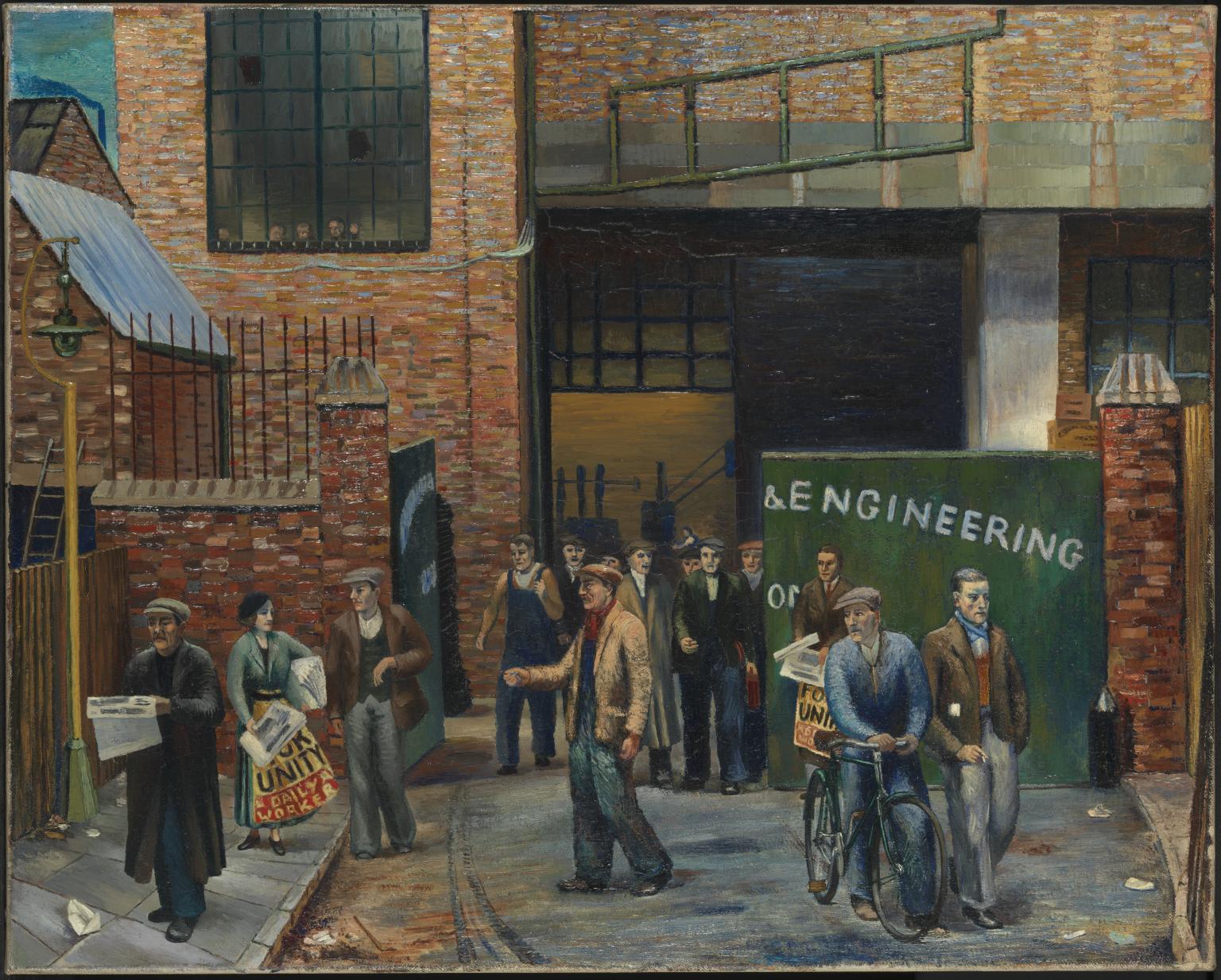
Bombed Women and Searchlights

- Artist: Clive Branson
- Date: 1940
- Medium: Oil paint on canvas
- Dimensions: support: 509 × 612 × 20 mm
- Museum: Tate Britain
- Collection record: Tate Britain website
Listen to the free audio guide
About this artwork
This is the “Bombed Women and Searchlights” by Clive Branson, painted in 1940 right after the Blitz began. Branson was living in Battersea, so he saw the night sky lit by barrage balloons and searchlights that sliced across a factory, a stark backdrop for the painting’s surreal tension.
On the left you’ll notice a determined woman—likely Branson’s wife, Noreen—she’s hauling something from a wrecked scene while a foreshortened chair, an empty cigarette packet, and a striped barrier create a jarring, almost dream‑like perspective. The right side offers a sharp contrast: a “Dig for Victory” poster encouraging home‑grown food, below it graffiti reading “Vote Joyce, Say Peace” that nods to the infamous broadcaster William Joyce, and a shop window banner declaring “Smile and say Victory”. These juxtapositions force you to confront the conflicting emotions of hope, propaganda, and the grim reality of war.
Branson, an active member of the Artists International Association, used this work to critique the war while channeling the surrealist’s visual intensity. He paused painting for political activism, helped found the Marx Memorial Library, and returned to painting after being a prisoner of war in Spain. Though he was sent to the Royal Armoured Corps in 1941 and died in Burma in 1944, his canvases like this one capture a moment of British society caught between resilience and propaganda.
See it in person
Bombed Women and Searchlights is in the collection of Tate Britain on Millbank, London — free to enter. Point your phone at any artwork there and audioguide.london plays a free audio guide in six languages — no app download needed.