Candelabrum
- Gallery: British Galleries, Room 120, The Wolfson Galleries
- Maker: Thomas Hopper (designer)
- Made in: England
- Date: 1810
- Object type: Candelabrum
- Materials: Cast artificial stone (Coade stone)
- Dimensions: Height 205.9 cm; Width 43.18 cm
- Museum: V&A South Kensington
- Collection record: V&A website
- Image © Victoria and Albert Museum, London.
Listen to the free audio guide
In the museum now? Point your phone at the next object and hear its guide.
About this object
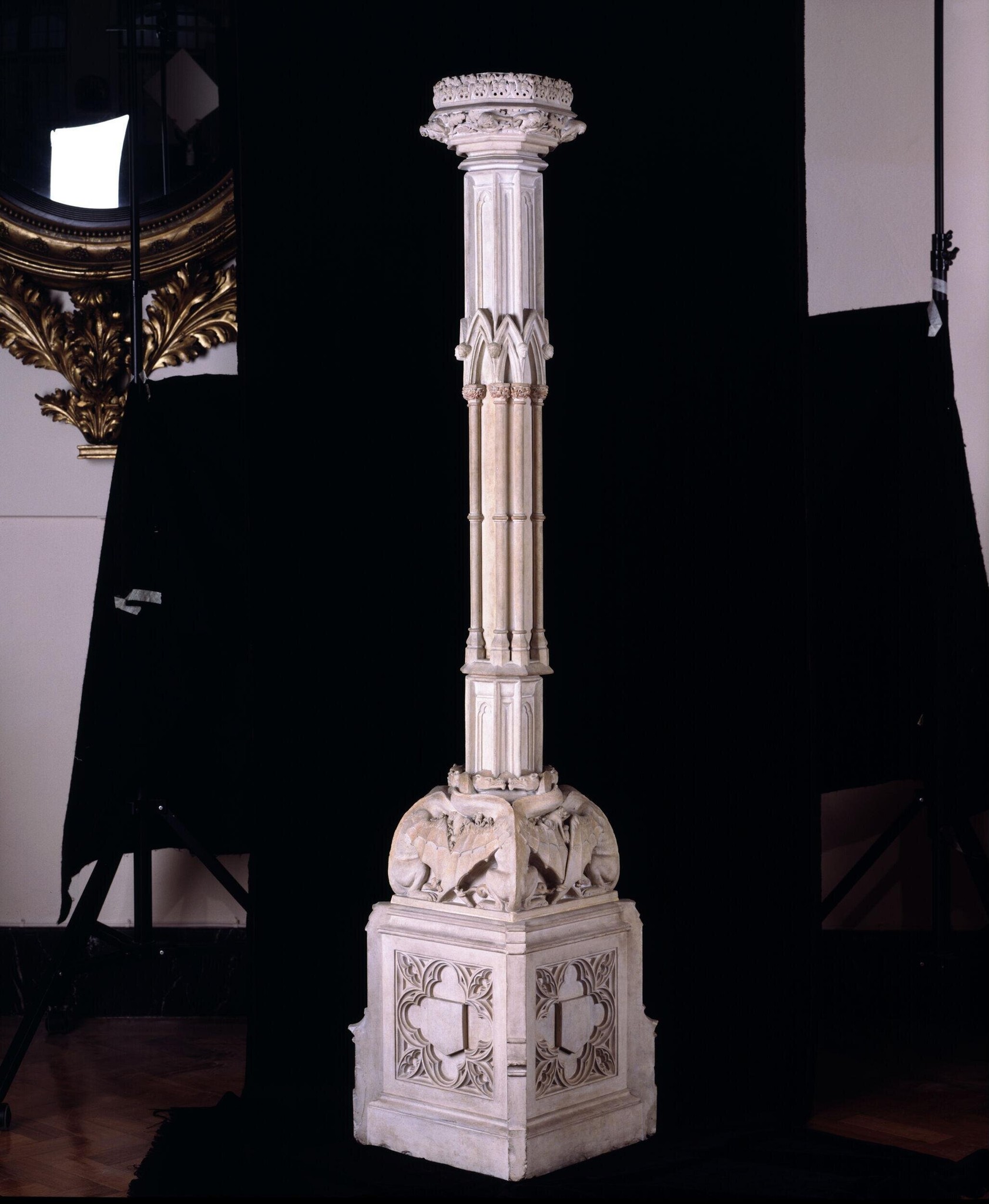
Before you is a "Candelabrum" made of Coade stone, a durable, cast artificial stone. This piece was designed by the architect Thomas Hopper in 1810 for a set of ten that once lit the conservatory at Carlton House, the London residence of the Prince Regent.
As you look closely at the details, you can see the influence of the Gothic Revival style. The stem features architectural motifs of pointed arches, while the top is carved with monkeys nestled in foliage. Around the base, look for the more fantastic elements: dragons with outspread wings and intertwining necks, alongside smaller figures like a squirrel, a monkey, and even a mother changing a baby's nappy.
Originally, these candelabra stood on black marble plinths and held brass lamps with six burners each. After Carlton House was demolished in 1827, these pieces were moved to Windsor Castle. The crisp, sharp details you see today demonstrate how well this special type of ceramic stone preserves its form over time.
See it in person
Candelabrum is on display in British Galleries, Room 120, The Wolfson Galleries at the V&A South Kensington on Cromwell Road, London — free to enter. Choose V&A South Kensington on audioguide.london and take a photo of it to hear this free audio guide in six languages — no app download needed.
New, in beta. V&A support has just launched and is still improving: 1,000 objects with audio so far, with more added all the time.