Candlestand
- Gallery: Medieval & Renaissance, Room 50b, The Paul and Jill Ruddock Gallery
- Made in: France
- Date: 1400-1500
- Object type: Candlestand
- Materials: Ironwork
- Dimensions: Height 250 cm; Width 65 cm
- Museum: V&A South Kensington
- Collection record: V&A website
- Image © Victoria and Albert Museum, London.
Listen to the free audio guide
In the museum now? Point your phone at the next object and hear its guide.
About this object
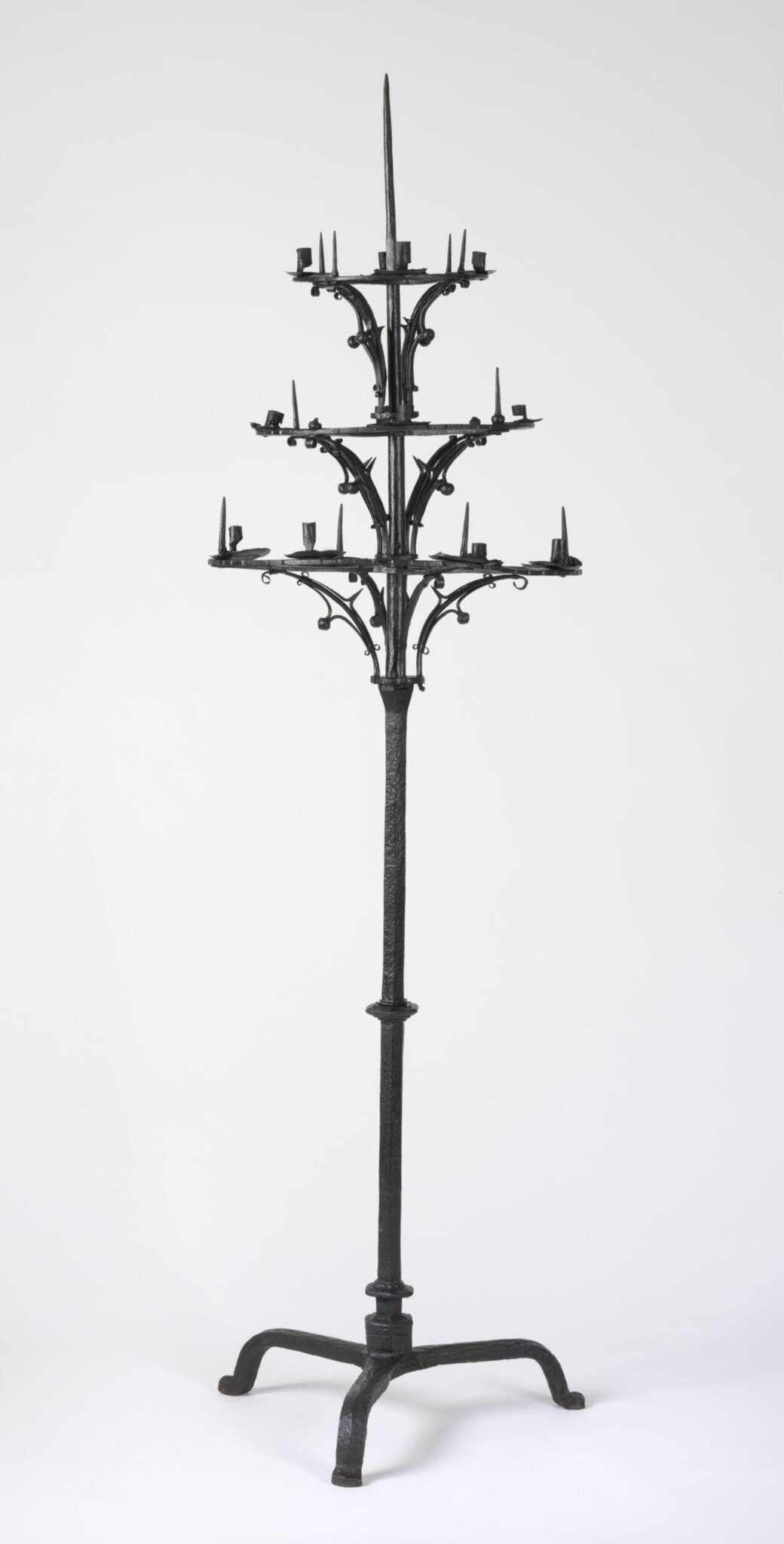
Before you is a large, wrought iron "Candlestand" from France, dating between the 1400s and 1500s. This impressive piece likely stood in a church choir or before a tomb.
Take a look at the tall stem, which features hexagonal and circular sections and rests on three curved feet. The most striking part of the design is the three revolving rings. Each ring contains alternating spikes and sockets to hold the candles. Because these rings could turn, it was much easier to add or snuff out the candles as needed. When lit for Mass, this stand would have been ablaze with light, throwing a glow over a wide area.
In Christian worship, candles held deep symbolic meaning, representing divine knowledge and life. During specific services known as tenebrae, or darkness, the candles in the choir were gradually extinguished to symbolize the darkness that fell during the crucifixion. This candlestick would have been a central part of such powerful, moving rituals.
See it in person
Candlestand is on display in Medieval & Renaissance, Room 50b, The Paul and Jill Ruddock Gallery at the V&A South Kensington on Cromwell Road, London — free to enter. Choose V&A South Kensington on audioguide.london and take a photo of it to hear this free audio guide in six languages — no app download needed.
New, in beta. V&A support has just launched and is still improving: 1,000 objects with audio so far, with more added all the time.