John Dalton
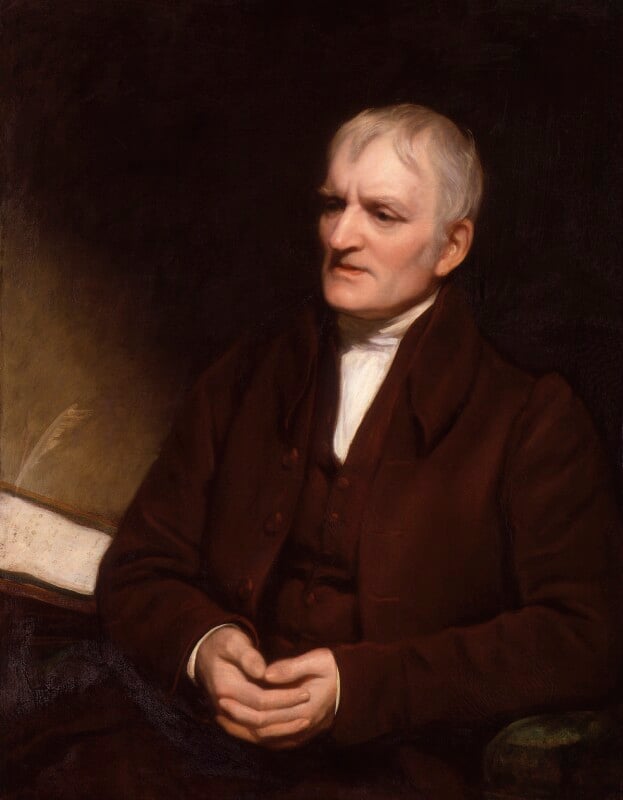
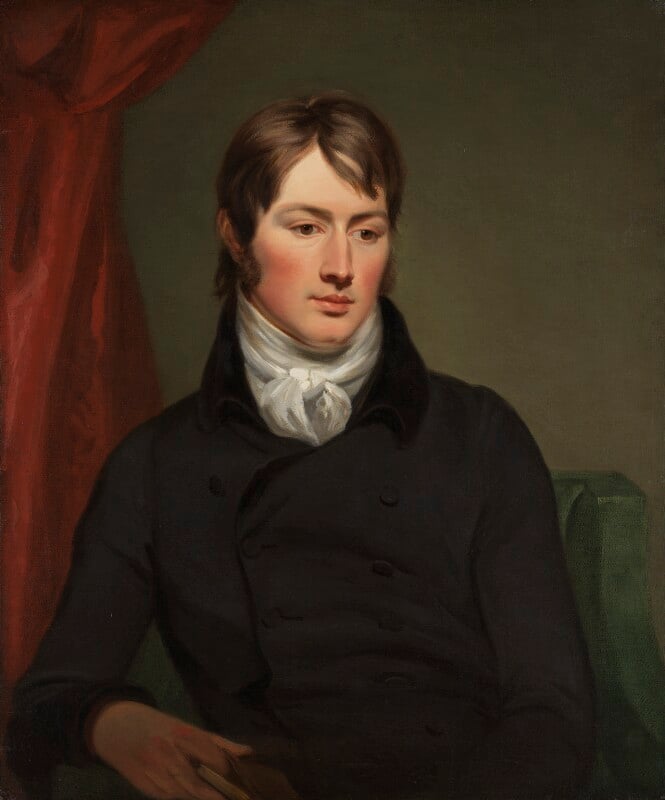
- Artist: Thomas Phillips
- Date: 1835
- Medium: oil on canvas
- Dimensions: 36 in. x 28 1/8 in. (914 mm x 714 mm)
- Portrays: John Dalton
- Museum: The National Portrait Gallery
- Collection record: The National Portrait Gallery website
Listen to the free audio guide
In the museum now? Point your phone at the next artwork and hear its guide.
About this artwork
This is a portrait of John Dalton, painted by Thomas Phillips in 1835 with oil on canvas. You see Dalton seated, his head turned slightly toward the viewer, eyes focused ahead. The brushwork shows Phillips’ subtle rendering of face and hands; a quiet expression that hints at a thinker’s mind.
Notice the frame: it uses the same heavy Regency scroll-and-foliage pattern that Phillips applied to many of his portraits in the 1810s and early 1820s. The corners have gentle shells and leaves set against a chequered ground, echoing the style he used for Sir Humphrey Davy and other works of that decade.
Dalton himself was born into a poor Quaker family but became a leading figure in Manchester’s scientific culture. He developed the Greeks’ atomic philosophy into a working theory, using wooden balls to represent atoms when demonstrating his ideas about gases under heat and pressure. He also gave the first description of red‑green colour blindness—“Daltonism”—after noticing it himself, an affliction that mainly affects boys.
The portrait therefore captures both the man’s likeness and the scientific spirit he helped forge.
See it in person
John Dalton is in the collection of The National Portrait Gallery at St Martin's Place, London — free to enter. Point your phone at any artwork there and audioguide.london plays a free audio guide in six languages — no app download needed.