Moses
- Gallery: Cast Courts, Room 46b, The Weston Cast Court
- Maker: Michelangelo (sculptor)
- Made in: Rome; Paris
- Date: 1513-1542
- Object type: Statue
- Materials: Plaster cast, painted plaster
- Dimensions: Height 236.5 cm; Width 109.5 cm
- Museum: V&A South Kensington
- Collection record: V&A website
- Image © Victoria and Albert Museum, London.
Listen to the free audio guide
In the museum now? Point your phone at the next object and hear its guide.
About this object
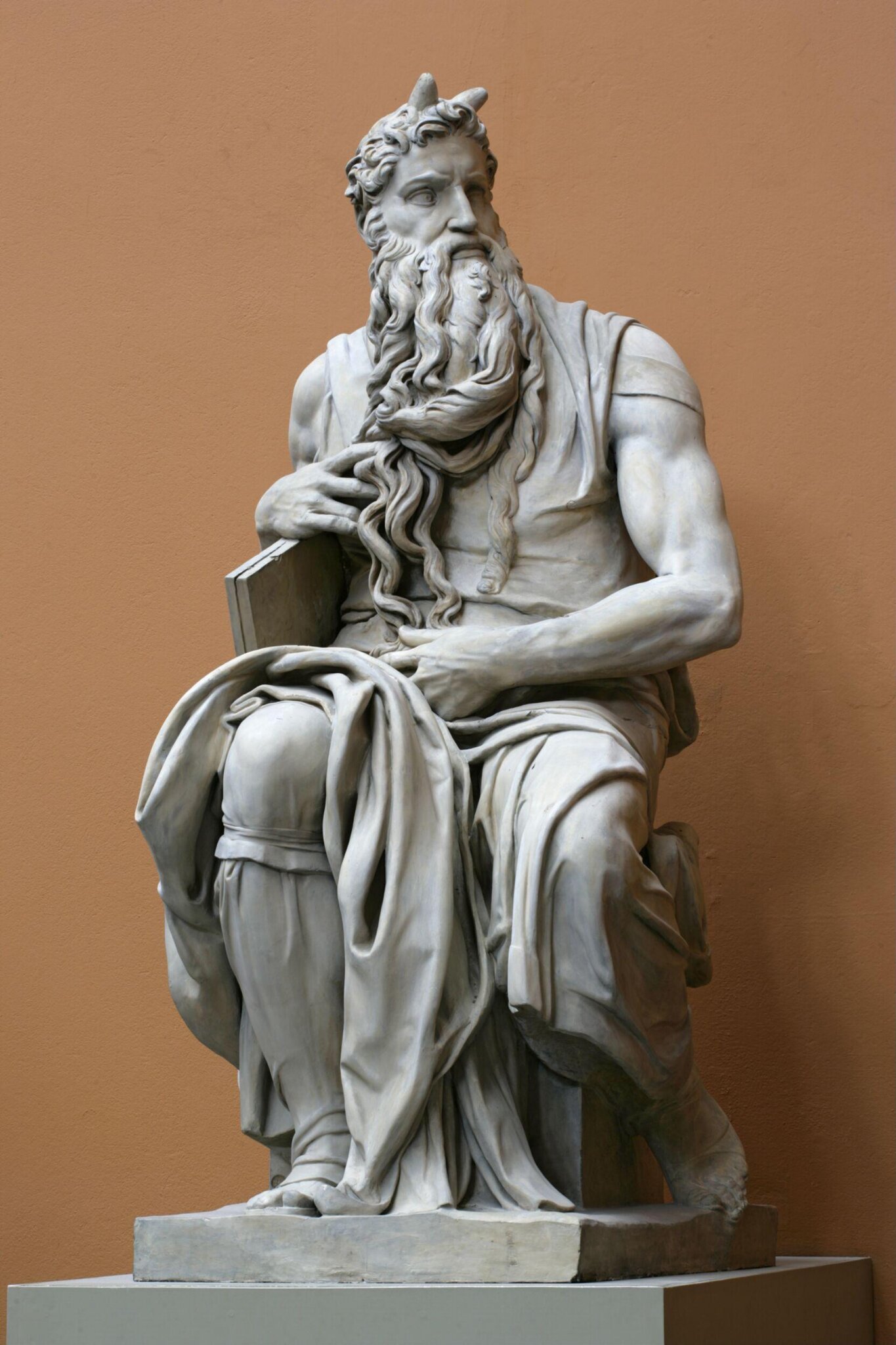
Before you is "Moses", a painted plaster cast of a famous sculpture by Michelangelo. This cast was made in Paris around 1858 by Monsieur Desachy, based on the original marble statue located in Rome.
The original marble figure was created for the tomb of Pope Julius the Second. While Michelangelo began this work early in the sixteenth century, he did not complete this imposing figure of Moses until 1542. Because the statue was originally designed to be viewed from a much higher position, its proportions can seem a bit awkward when seen from down here.
As you look at the figure, you might notice that Moses is depicted with horns. This is a traditional attribute in European art, though it is actually a historical misinterpretation. It comes from a biblical description of Moses descending from Mount Sinai; the Hebrew word for ray was translated as horns, leading to this unique detail. Moses is shown holding the tablets of the law, captured with the dramatic energy that has made this work so celebrated for centuries.
See it in person
Moses is on display in Cast Courts, Room 46b, The Weston Cast Court at the V&A South Kensington on Cromwell Road, London — free to enter. Choose V&A South Kensington on audioguide.london and take a photo of it to hear this free audio guide in six languages — no app download needed.
New, in beta. V&A support has just launched and is still improving: 1,000 objects with audio so far, with more added all the time.