Pedal harp
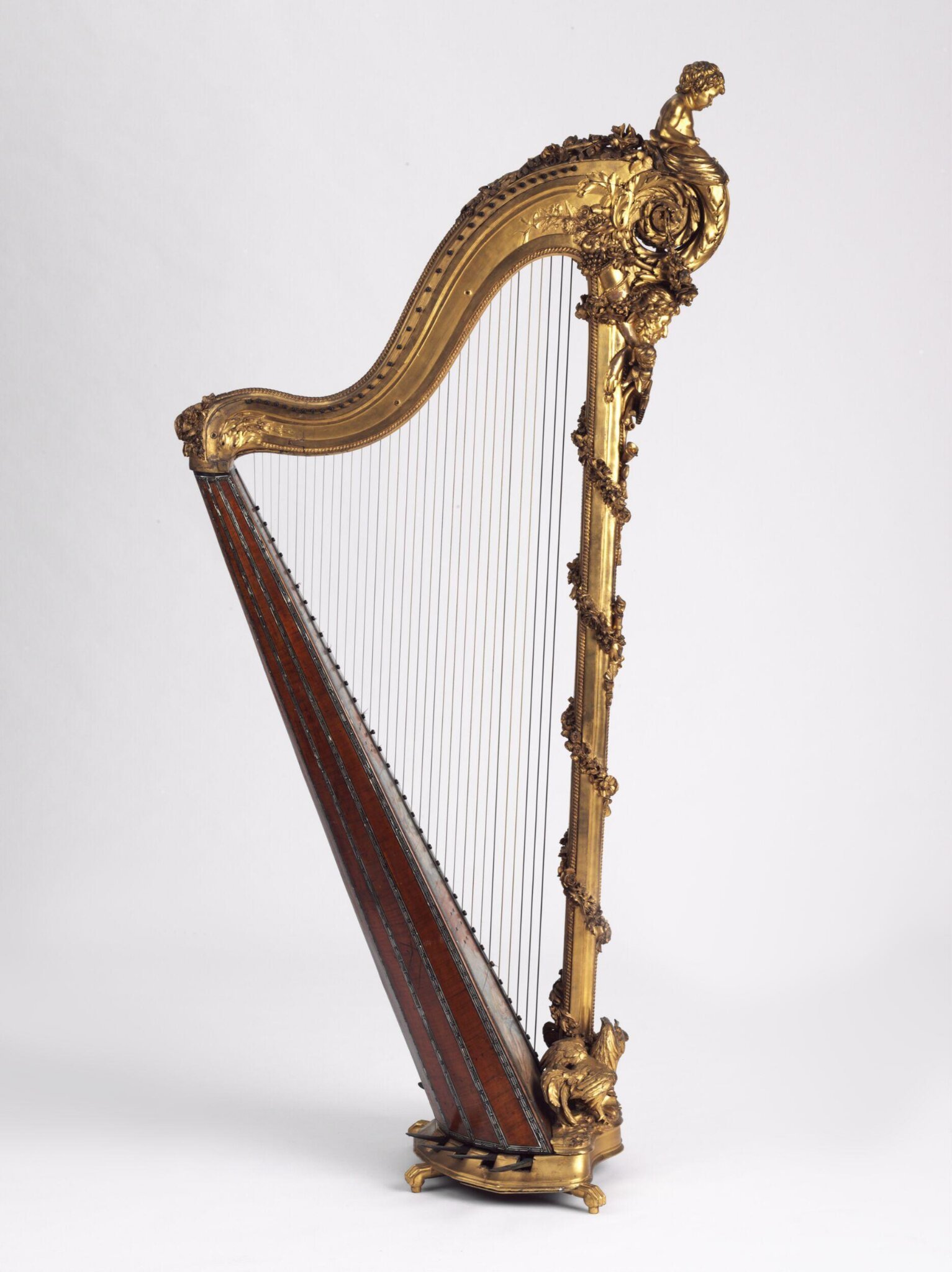
- Gallery: Europe 1600-1815, Room 1
- Maker: Georges Cousineau (maker)
- Made in: Paris
- Date: ca. 1785
- Object type: Pedal harp
- Materials: Carved, gilt, planed and painted pine, with metal mechanisms
- Dimensions: Height 168 cm; Width 750 mm; Depth 930 mm
- Museum: V&A South Kensington
- Collection record: V&A website
- Image © Victoria and Albert Museum, London.
Listen to the free audio guide
In the museum now? Point your phone at the next object and hear its guide.
About this object
Before you is a "Pedal harp" made in Paris around 1785. This elegant instrument was crafted from pine that has been carved, gilded, and painted. If you look closely at the belly of the harp, you can see it is decorated with six figures playing musical instruments.
The maker, Georges Cousineau, was one of the leading harp makers of his time. He was even appointed as the luthier to Queen Marie Antoinette in 1775, a title inscribed on a painted ribbon on this very piece. This harp features a special metal mechanism that Cousineau invented to allow for much more accurate tuning. By using seven pedals at the base, a player could adjust the strings by a semi-tone more precisely than ever before.
The decoration is exceptionally rich, featuring a pillar entwined with a garland of carved flowers and musical instruments. Such a lavish instrument would have been perfect for the elegant salons of Paris in the decades leading up to the French Revolution.
See it in person
Pedal harp is on display in Europe 1600-1815, Room 1 at the V&A South Kensington on Cromwell Road, London — free to enter. Choose V&A South Kensington on audioguide.london and take a photo of it to hear this free audio guide in six languages — no app download needed.
New, in beta. V&A support has just launched and is still improving: 1,000 objects with audio so far, with more added all the time.