The Luck of Edenhall
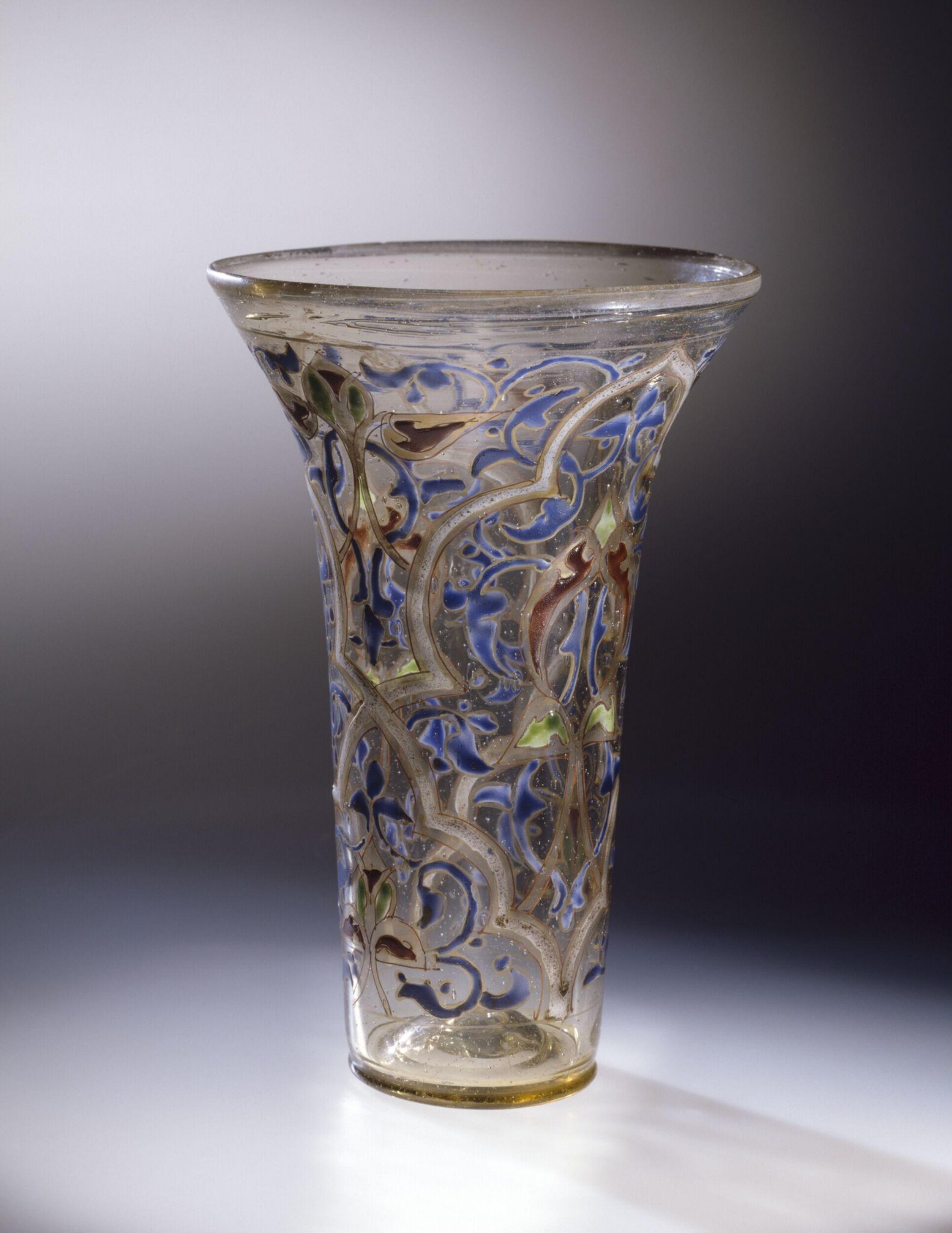
- Gallery: Medieval & Renaissance, Room 10a, The Françoise and Georges Selz Gallery
- Object type: Beaker and case
- Materials: Glass, enamelled and gilded
- Style: Mamluk
- Dimensions: Height (beaker) 16 cm
- Museum: V&A South Kensington
- Collection record: V&A website
- Image © Victoria and Albert Museum, London.
Listen to the free audio guide
In the museum now? Point your phone at the next object and hear its guide.
About this object
Before you is "The Luck of Edenhall", a beautiful glass beaker decorated with blue, green, red, and white enamel and gold. This piece was likely made in Egypt or Syria during the middle of the 14th century. It is accompanied by a finely tooled leather case, which may have been made in France or England between the 1400s and 1500s.
The case features the IHS symbol, a Christian sign representing the name of Jesus, which may have been added as a charm to protect the glass. This object eventually traveled to northern England, where it became associated with the Musgrave family of Edenhall.
The name reflects a local belief that the beaker held magical powers. In this region, a luck was a luxury object thought to bring good fortune to its owners. It was believed that if the vessel ever broke, that good fortune would be lost forever. Local legends even claimed the cup was left behind by a party of fairies, accompanied by a warning that if the cup should break or fall, the luck of Edenhall would be gone.
See it in person
The Luck of Edenhall is on display in Medieval & Renaissance, Room 10a, The Françoise and Georges Selz Gallery at the V&A South Kensington on Cromwell Road, London — free to enter. Choose V&A South Kensington on audioguide.london and take a photo of it to hear this free audio guide in six languages — no app download needed.
New, in beta. V&A support has just launched and is still improving: 1,000 objects with audio so far, with more added all the time.