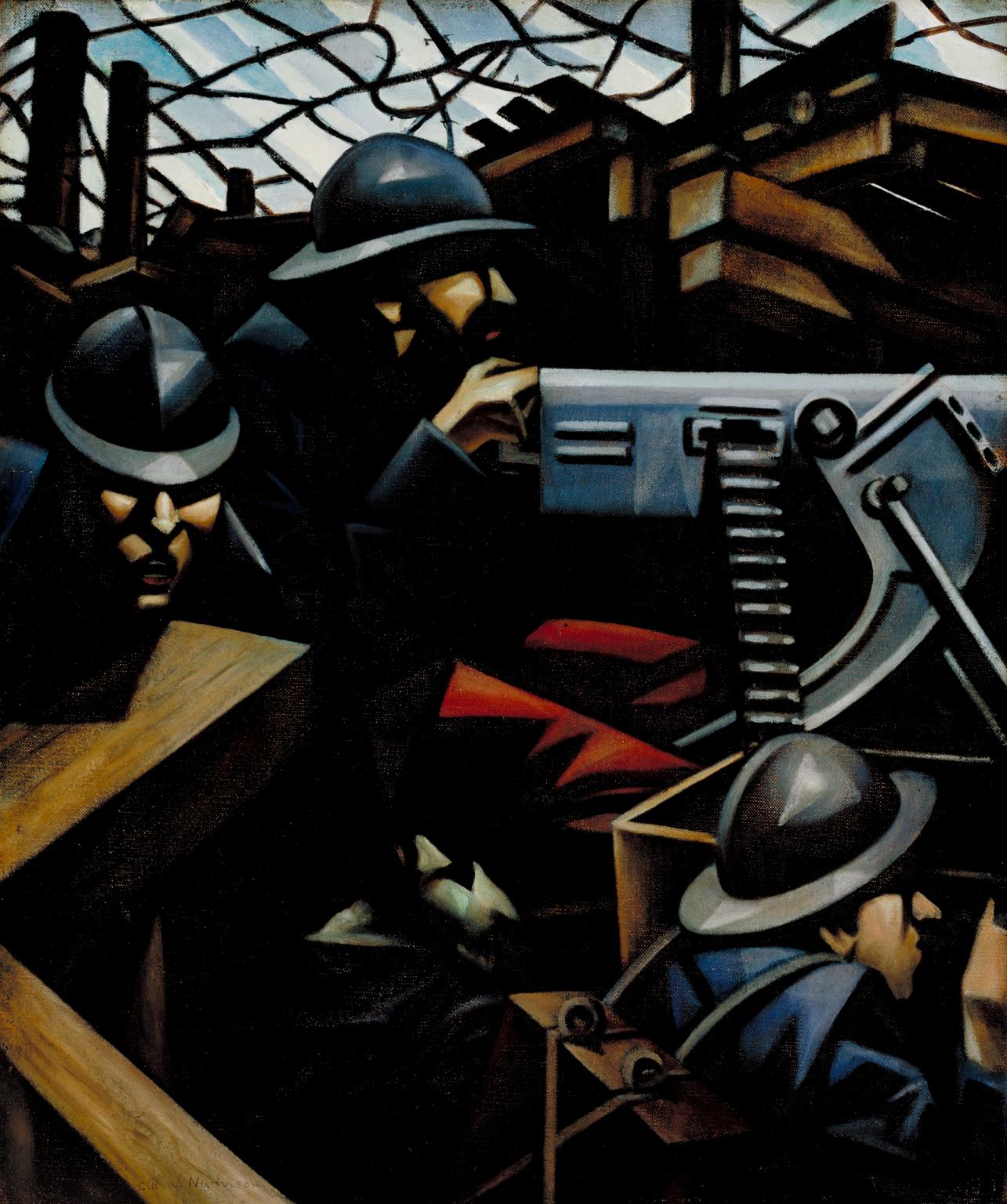
Bursting Shell

- Artist: Christopher Richard Wynne Nevinson
- Date: 1915
- Medium: Oil paint on canvas
- Dimensions: support: 760 x 560 mm
- Museum: Tate Britain
- Collection record: Tate Britain website
Listen to the free audio guide
About this artwork
This is the *Bursting Shell* by Christopher Richard Wynne Nevinson, painted in 1915. The work is a striking example of early 20th‑century war art that blends the angular dynamism of Vorticism with the kinetic energy of Futurism. Nevinson uses thick, black outlines and sharp angles to break up the silhouettes of buildings and roads into shards of debris and shadow. In the centre, a bright, swirling spiral erupts—an almost hypnotic vortex of light that conveys the dizzying, disorienting moment of an explosion.
The canvas, about 30 by 22 inches, feels almost alive with motion; the dark shapes seem to leap off the surface as if they’re crashing inward from the blast. It’s not just a depiction of destruction, but a visual assault on the senses, a reminder that the war had become an almost inevitable, mechanised nightmare. The painting first appeared in the Goupil Gallery in late 1915, right in the midst of the conflict, and it has since been shown in exhibitions that explore the intersections of art, war, and modernity. Its impact lies in how Nevinson translates the physical reality of shellfire into a powerful, almost abstract visual language that still feels immediate to us today.
See it in person
Bursting Shell is in the collection of Tate Britain on Millbank, London — free to enter. Point your phone at any artwork there and audioguide.london plays a free audio guide in six languages — no app download needed.