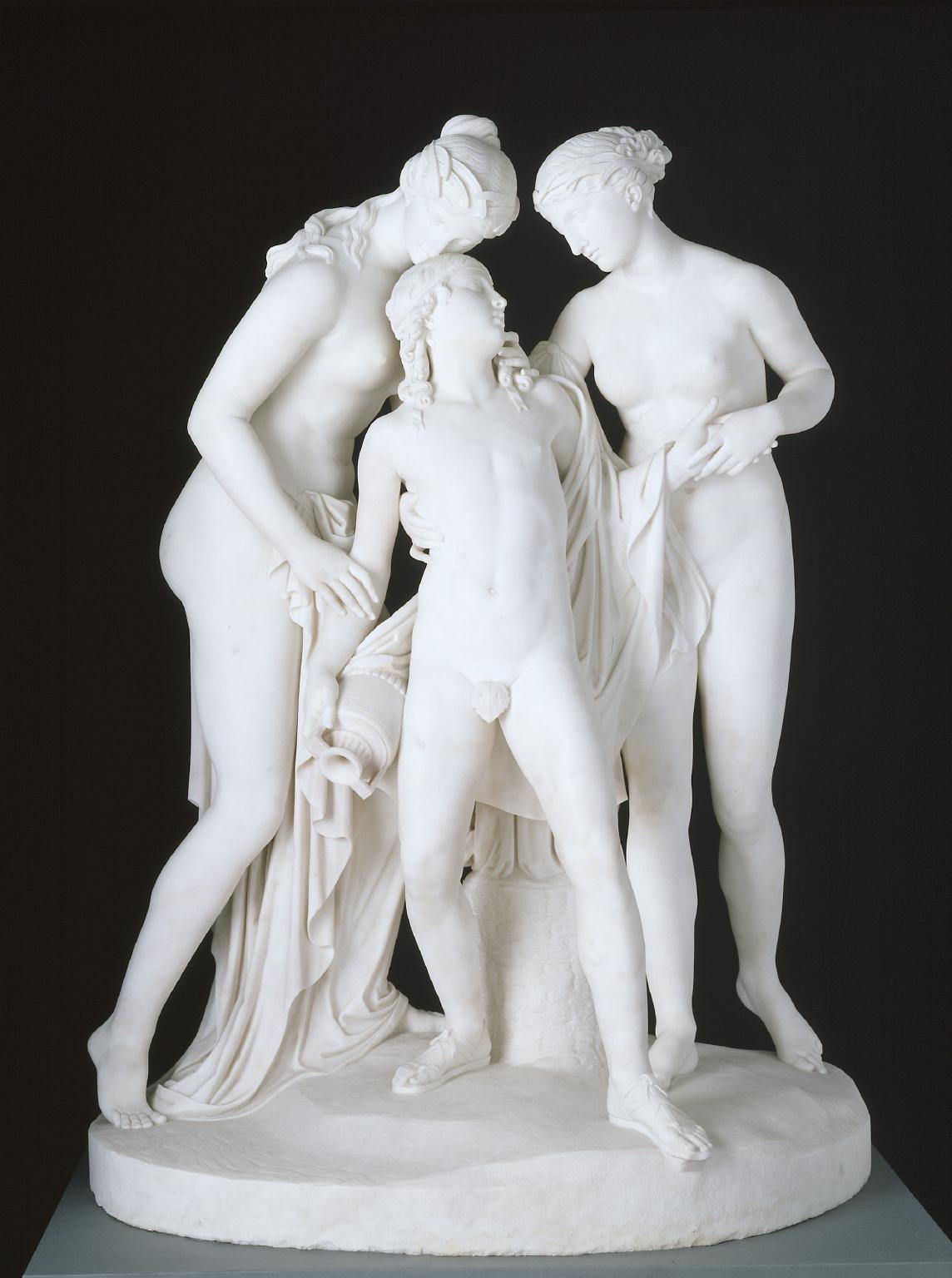
Bust of William Bewick

- Artist: John Gibson
- Date: 1827–53
- Medium: Marble
- Dimensions: object: 570 x 300 x 230 mm, 54 kg
- Museum: Tate Britain
- Collection record: Tate Britain website
Listen to the free audio guide
About this artwork
This is “Bust of William Bewick” by John Gibson. The white marble portrait shows the early‑adulthood of the British painter William Bewick (1795–1866). The figure is moustached, almond‑shaped eyes left blank – a deliberate neoclassical choice that gives it a calm, idealised air. Gibson worked in Rome for nearly ten years before Bewick arrived in 1826. The sculptor had already set up his studio on Via della Fontanella, a hub for visiting British artists. When Bewick came, the two met and quickly bonded over conversations about “fine antique statues.” It was this friendship that led Gibson to sit down in 1827 and model a plaster bust from life in his Rome studio; it later went into marble at the behest of Bewick’s wife, Elizabeth Quelch, in 1847 for a modest fee of twenty‑five pounds. The finished piece measures about 570 × 300 × 230 mm and weighs roughly 54 kg – life‑size but rendered with subtle simplicity. Its symmetry and smooth detailing are typical of Gibson’s neoclassical style, influenced by the works of Canova and Thorvaldsen. Today it sits in Tate Britain’s Historic and Modern British Art display, a quiet testament to two artists’ shared love for classical form and the camaraderie that thrummed through Rome’s artist community in the early 1800s.
See it in person
Bust of William Bewick is in the collection of Tate Britain on Millbank, London — free to enter. Point your phone at any artwork there and audioguide.london plays a free audio guide in six languages — no app download needed.