Faraday chair
- Gallery: Design 1900 to Now, Room 76
- Maker: Dunne & Raby (designers)
- Made in: Great Britain
- Date: 1995
- Object type: Chair
- Materials: Welded steel frame, acrylic, silicon, cotton pillow
- Dimensions: Height 71.8 cm; Width 125 cm; Depth 72 cm
- Museum: V&A South Kensington
- Collection record: V&A website
- Image © Victoria and Albert Museum, London.
Listen to the free audio guide
In the museum now? Point your phone at the next object and hear its guide.
About this object
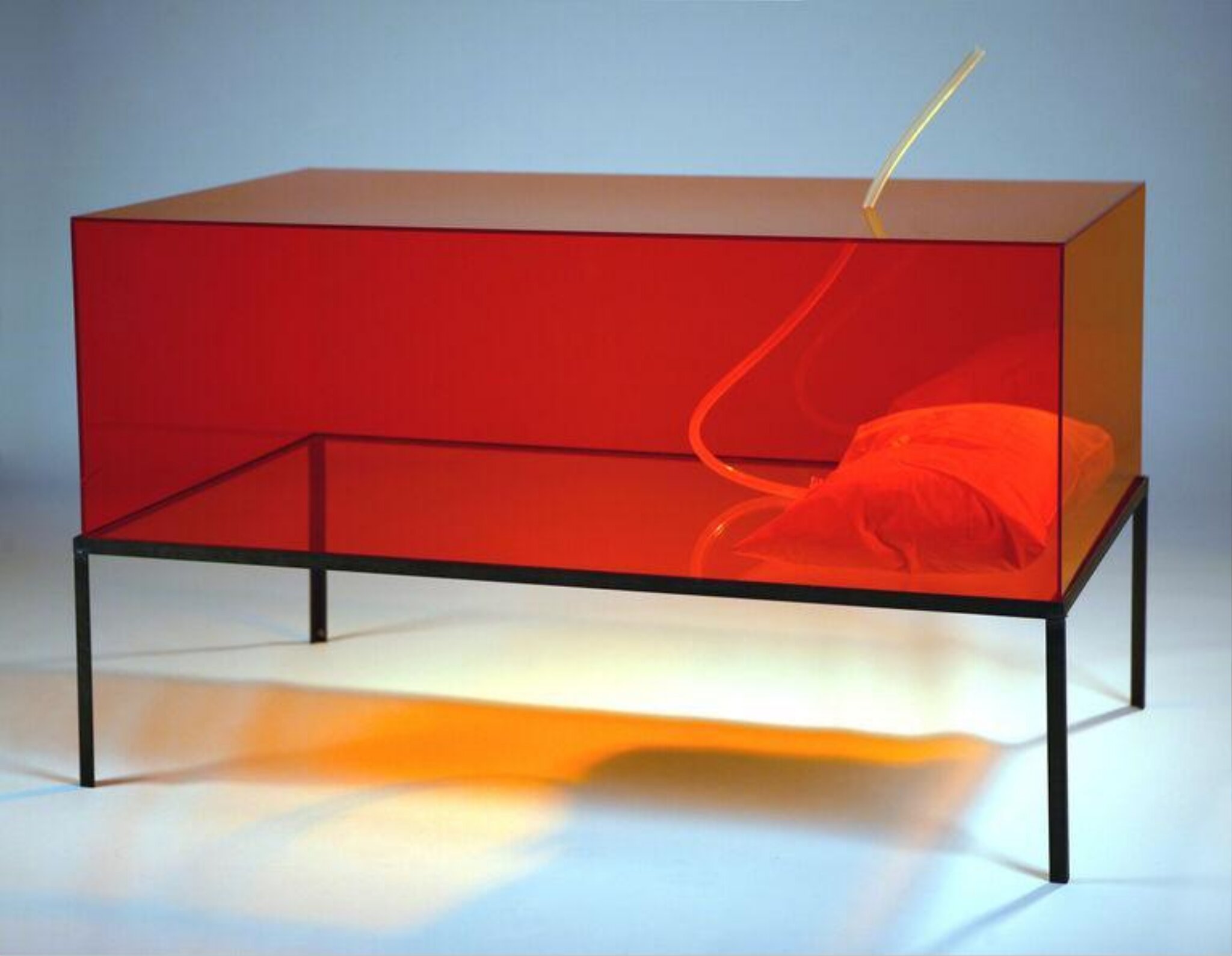
Before you is the "Faraday chair," a conceptual work designed by Dunne and Raby in 1995. It looks less like a traditional seat and more like a translucent orange tank. This oblong acrylic box is suspended within a steel frame and contains a loose cotton pillow. If you look closely at the top, you will see a single silicon tube that hangs down toward a mouthpiece.
The chair is named after Michael Faraday, a pioneer in electrical research. The designers used this name to suggest that the tank acts as a protective sanctuary, shielding the user from the invisible electromagnetic waves produced by modern appliances like televisions and mobile phones.
While the tank is large enough for an adult to lie in a foetal position, its shape can feel both womb-like and restrictive, almost like a sarcophagus. Because it would not actually block electrical waves, it remains a prototype—a piece of conceptual design meant to provoke questions about our relationship with the digital world and our need for psychological comfort.
See it in person
Faraday chair is on display in Design 1900 to Now, Room 76 at the V&A South Kensington on Cromwell Road, London — free to enter. Choose V&A South Kensington on audioguide.london and take a photo of it to hear this free audio guide in six languages — no app download needed.
New, in beta. V&A support has just launched and is still improving: 1,000 objects with audio so far, with more added all the time.