The Three Graces
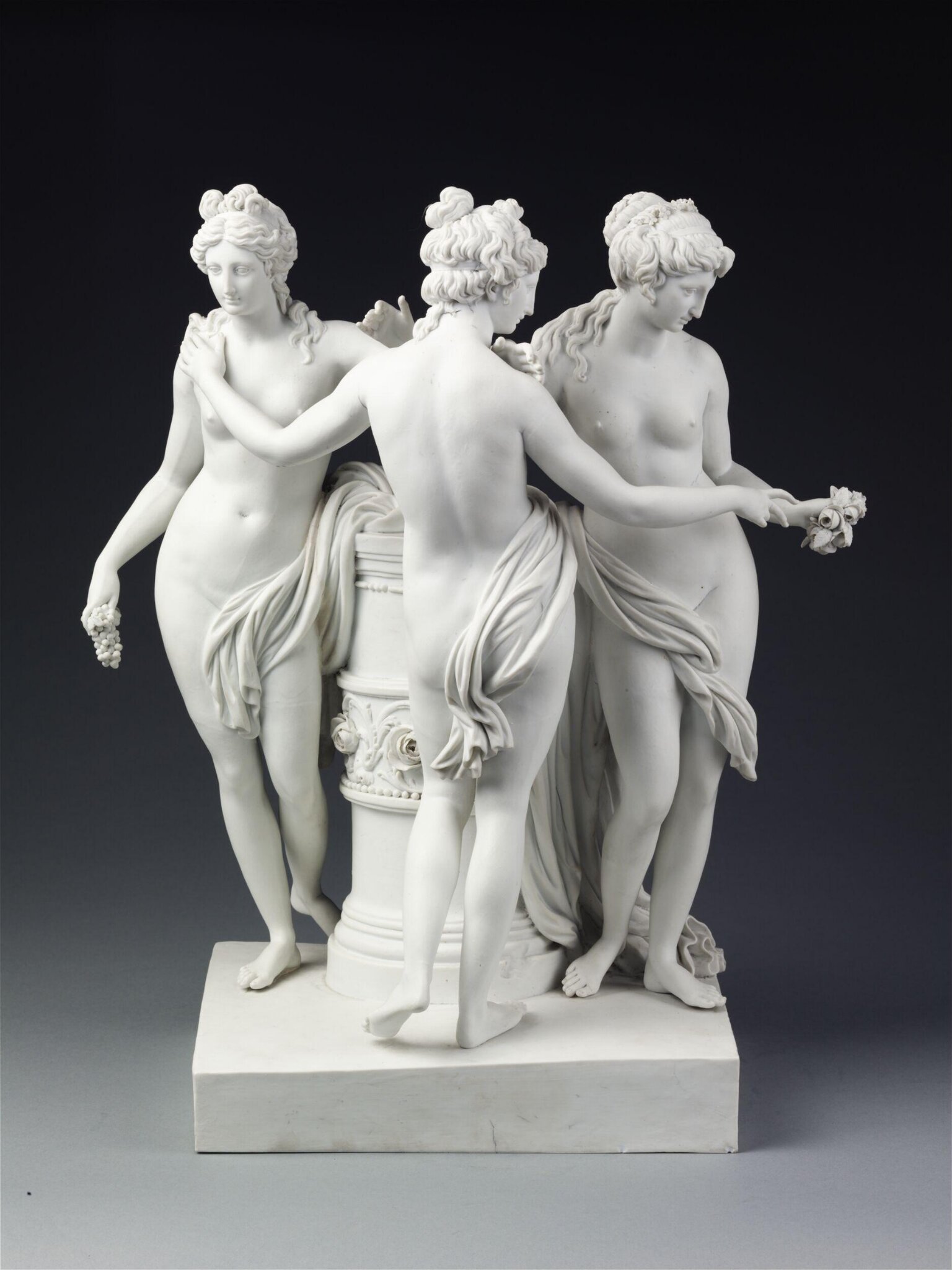
- Gallery: Europe 1600-1815, Room 1
- Maker: Christian Gotfried Jüchtzer (modeller)
- Made in: Meissen
- Date: ca. 1785
- Object type: Figure group
- Materials: Hard-paste biscuit porcelain
- Dimensions: Height 405 mm; Width (base) 235 mm; Width (whole) 375 mm
- Museum: V&A South Kensington
- Collection record: V&A website
- Image © Victoria and Albert Museum, London.
Listen to the free audio guide
In the museum now? Point your phone at the next object and hear its guide.
About this object
Before you is "The Three Graces", a delicate figure group made of hard-paste biscuit porcelain. Created at the Meissen porcelain factory in Germany around 1785, this piece was modelled by Christian Gotfried Jüchtzer.
The group depicts the Three Graces from classical Greek mythology: Aglaea, Euphrosyne, and Thalia. They represent charm, beauty, and joy, and were known as the companions of Aphrodite, Apollo, and Athena. In this composition, the three nude figures are linked by their arms, standing together by a circular altar. Notice how they are supported by an elaborate column, a detail that sets this version apart from other classical inspirations.
This arrangement was likely inspired by a marble sculpture in Rome, which featured flowers held by the outer figures. This specific model was so popular at the Meissen factory that the moulds required repair just a few years after they were first used.
See it in person
The Three Graces is on display in Europe 1600-1815, Room 1 at the V&A South Kensington on Cromwell Road, London — free to enter. Choose V&A South Kensington on audioguide.london and take a photo of it to hear this free audio guide in six languages — no app download needed.
New, in beta. V&A support has just launched and is still improving: 1,000 objects with audio so far, with more added all the time.